
Sleep fulfills vital functions for the brain and body. However, sleep is not a uniform state: alternating substates and oscillation patterns show rich variations on different time scales. In the Sleep & Memory Lab, based at the Donders Institute in Nijmegen, The Netherlands, we aim to uncover the mechanisms behind this variability and their specific role in the functions of sleep. We are particularly interested in the following topics:
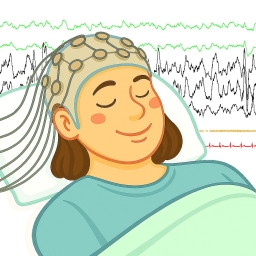 |
Sleep physiology. From an evolutionary point of view, spending hours in a non-responsive state seems strikingly non-adaptive. Sleep thus serves several vital functions to overcompensate for this disadvantage. In our lab, we develop new strategies to understand the structure of sleep on the micro- (sleep stages and microprocesses), meso- (sleep cycles), and macro-level (sleep regularity), with the aim to map the richness of sleep physiology to the different functions of sleep. |
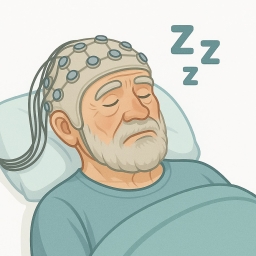 |
Clinical applications. Sleep disturbances are the leading transdiagnostic symptom of and likely causal contributor to the development of psychiatric and neurological diseases. We focus in particular on two areas of mental health to help translate sleep research insights into clinical applications and health care innovations: How is sleep involved stress-related disorders, and how is brain clearance during sleep impaired in neurodegenerative diseases? |
 |
Sleep research methods. Polysomnography as the gold standard in sleep research generates rich and multimodal datasets. However, considering the massive costs and thus resulting small sample sizes of this method, we help to transfer sleep research from small-scale lab environments to large-scale clinical and home settings. We develop and validate new tools for the recording and analysis of sleep data, from minimal sleep EEG headbands to analysis pipelines for big sleep data. |
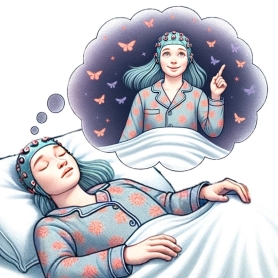 |
Dreaming. Conscious experience fluctuates considerably across the sleep-wake cycle: alert attention alternates with mind wandering, sleep onset imagery, dreamless sleep and vivid dreaming. We study consciousness during sleep, considering the phenomenon of lucid dreaming particularly interesting as both a model case and tool. In addition to fundamental insights into the functions and neural correlates of dreaming, we develop and validate different dream engineering strategies to modulate dream experiences. |
 |
Memory. Memory skills differ across the general population – from age-related memory decline to the outstanding feats of memory champions. In addition to the role of sleep in memory processing, we investigate different strategies of learning and memory enhancement, with a focus on the mnemonic training strategies used in memory sports. Beyond the efficacy of mnemonics in naïve subjects, developmental contexts and age-related decline, we are particularly interested in the neural mechanisms underlying mnemonic training and superior memory skills. |
 Donders Sleep & Memory Lab | Martin Dresler